
The Truth About Spray Foam Insulation

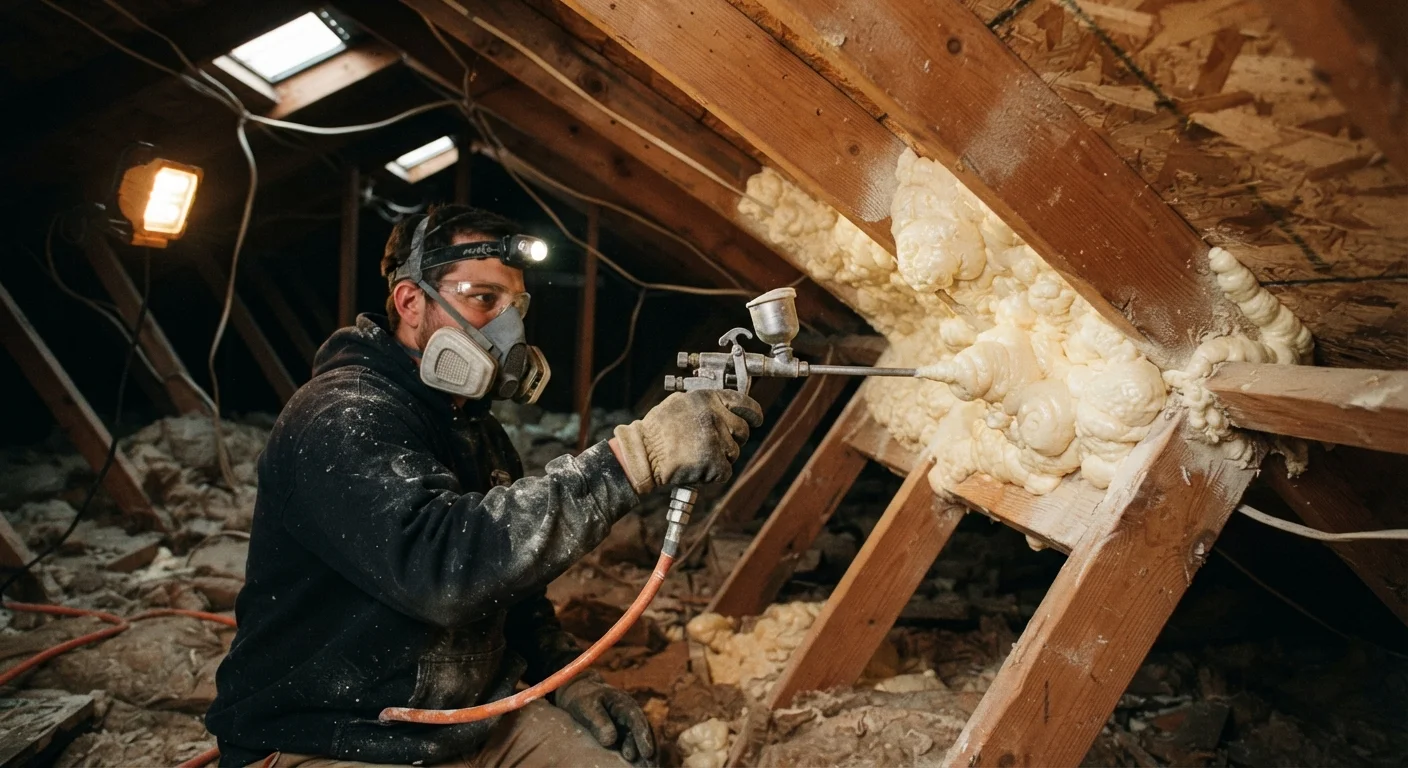
Photo: TargetReads.com | Explore Engaging Reads editorial
Key Takeaways
- Spray foam delivers the highest R-value per inch of any common insulation material.
- Closed-cell spray foam acts as both an air barrier and a vapor barrier, offering dual protection.
- Professional installation is strongly recommended — improper mixing creates toxic, uncurable foam.
- Spray foam is difficult and costly to remove, making it a long-term commitment to your home's structure.
- Open-cell and closed-cell foam have different strengths; choosing the wrong type can cause moisture problems.
Highest R-value per inch of common insulation types
Closed-cell foam reaches R-6 to R-7 per inch, outperforming fiberglass, cellulose, and open-cell foam — meaning more thermal resistance in thinner applications.
Seals air leaks while insulating simultaneously
Unlike batts, which require separate air-sealing work, spray foam bonds to surfaces and fills gaps as it expands, addressing two problems in one application.
Adheres to irregular and hard-to-reach surfaces
Spray foam conforms to any shape, making it effective in rim joists, around pipes, and in oddly framed spaces where rigid or batt insulation cannot fit cleanly.
Closed-cell type adds structural rigidity
When applied to wall sheathing or roof decking, closed-cell foam bonds layers together and can increase the racking strength — resistance to lateral forces — of a wall assembly.
Long service life with minimal degradation
Properly installed spray foam does not sag, settle, or compress over time the way fiberglass batts can, maintaining its performance characteristics for the life of the structure.
Significantly higher cost than alternative insulation
Spray foam installation typically costs two to three times more per square foot than fiberglass or blown-in cellulose, making whole-house applications a major budget commitment.
Extremely difficult and costly to remove
Once cured, spray foam bonds aggressively to framing and sheathing. Removal requires mechanical grinding or cutting, which risks damaging the structural components underneath.
Can conceal moisture damage and pest activity
Spray-foamed roof decking and wall cavities cannot be visually inspected for rot, mold, or pest intrusion — a genuine concern that home inspectors frequently raise.
Improper installation creates indoor air quality risks
Off-ratio mixing produces foam that never fully cures and continues to off-gas irritants. The EPA has documented indoor air quality complaints linked to improperly applied SPF.
Wrong foam type can trap or drive moisture
Using closed-cell foam in a climate or location where vapor needs to escape — such as certain wall assemblies in mixed climates — can concentrate moisture and accelerate rot.
What Spray Foam Actually Is
Spray polyurethane foam (SPF) is a two-component insulation material — isocyanate and polyol resin — that chemically react on contact to expand and harden. Contractors apply it with a spray gun, and it fills cavities, gaps, and irregular surfaces far more completely than fiberglass batts or blown-in cellulose can.
There are two primary types: open-cell foam, which is softer, lighter, and more affordable but allows moisture vapor to pass through; and closed-cell foam, which is denser, harder, and acts as both an air barrier and a vapor retarder. Closed-cell foam achieves an R-value (a measure of thermal resistance) of roughly R-6 to R-7 per inch, compared to open-cell's R-3.5 to R-4. For reference, standard fiberglass batts run about R-3 per inch.
Understanding which type fits your situation — and your climate — is where many homeowners go wrong before they even pick up the phone to call a contractor.
Open-Cell vs. Closed-Cell: Climate Matters
Where Spray Foam Performs Best
Spray foam's ability to conform to any shape makes it particularly effective in specific areas of a home where air leakage is the primary problem rather than just heat transfer.
Highest R-value per inch of common insulation types
Closed-cell foam reaches R-6 to R-7 per inch, outperforming fiberglass, cellulose, and open-cell foam — meaning more thermal resistance in thinner applications.
Seals air leaks while insulating simultaneously
Unlike batts, which require separate air-sealing work, spray foam bonds to surfaces and fills gaps as it expands, addressing two problems in one application.
Adheres to irregular and hard-to-reach surfaces
Spray foam conforms to any shape, making it effective in rim joists, around pipes, and in oddly framed spaces where rigid or batt insulation cannot fit cleanly.
Closed-cell type adds structural rigidity
When applied to wall sheathing or roof decking, closed-cell foam bonds layers together and can increase the racking strength — resistance to lateral forces — of a wall assembly.
Long service life with minimal degradation
Properly installed spray foam does not sag, settle, or compress over time the way fiberglass batts can, maintaining its performance characteristics for the life of the structure.
Rim joists — the wood framing at the top of your foundation walls — are notoriously difficult to seal with batts alone. Spray foam bonds directly to concrete and wood, eliminating the gaps that drive up heating bills. Similarly, attic hatches, knee walls, and around plumbing penetrations all benefit from spray foam's gap-filling properties. In crawl spaces, closed-cell foam on the walls and band joists can transform a damp, drafty zone into a conditioned space that protects pipes and floor systems.
The Real Drawbacks Homeowners Should Know
Spray foam's strengths are genuine, but so are its limitations — and they tend to be underemphasized in promotional materials.
Significantly higher cost than alternative insulation
Spray foam installation typically costs two to three times more per square foot than fiberglass or blown-in cellulose, making whole-house applications a major budget commitment.
Extremely difficult and costly to remove
Once cured, spray foam bonds aggressively to framing and sheathing. Removal requires mechanical grinding or cutting, which risks damaging the structural components underneath.
Can conceal moisture damage and pest activity
Spray-foamed roof decking and wall cavities cannot be visually inspected for rot, mold, or pest intrusion — a genuine concern that home inspectors frequently raise.
Improper installation creates indoor air quality risks
Off-ratio mixing produces foam that never fully cures and continues to off-gas irritants. The EPA has documented indoor air quality complaints linked to improperly applied SPF.
Wrong foam type can trap or drive moisture
Using closed-cell foam in a climate or location where vapor needs to escape — such as certain wall assemblies in mixed climates — can concentrate moisture and accelerate rot.
The cost difference is significant: closed-cell spray foam typically runs two to three times more per square foot than fiberglass or cellulose, depending on your region and installer. That premium can make sense in targeted applications but becomes hard to justify when insulating large, accessible wall cavities where batts perform nearly as well at a fraction of the price.
The permanence issue deserves special attention. If a roof leak develops inside spray-foamed roof decking, detecting and accessing the damage becomes substantially harder. Some home inspectors flag spray-foamed attics because they can't visually inspect the sheathing for rot or pest damage.
R-6 to R-7
Per-inch R-value of closed-cell spray foam
Closed-cell SPF consistently outperforms other common residential insulation types per inch of thickness, according to the U.S. Department of Energy.
~40%
Of home energy loss attributed to air leakage
The U.S. Department of Energy estimates that air infiltration accounts for a significant share of heating and cooling loss in typical American homes, underscoring why air-sealing insulation matters.
DIY Kits vs. Professional Installation
Small two-part spray foam kits are widely available for sealing gaps around pipes, windows, and electrical penetrations — tasks well within a confident homeowner's abilities. For anything beyond spot repairs, however, professional installation is the responsible choice.
Full-scale spray foam application requires protective equipment, precise temperature control during mixing, and proper ventilation. If the two components are mixed off-ratio — even slightly — the resulting foam may never fully cure. Uncured foam off-gases chemicals that can cause respiratory irritation and may require costly professional remediation to remove. The U.S. Environmental Protection Agency (EPA) has issued guidance noting that improper SPF installation is a known indoor air quality concern.
Even after a professionally applied job, occupants are generally advised to vacate the space for at least 24 hours while the foam fully cures and ventilates.
The content on this site is for informational purposes only and is not a substitute for professional advice. Always consult a qualified professional for guidance specific to your situation.