
What Deductibles Actually Do Inside an Insurance Policy

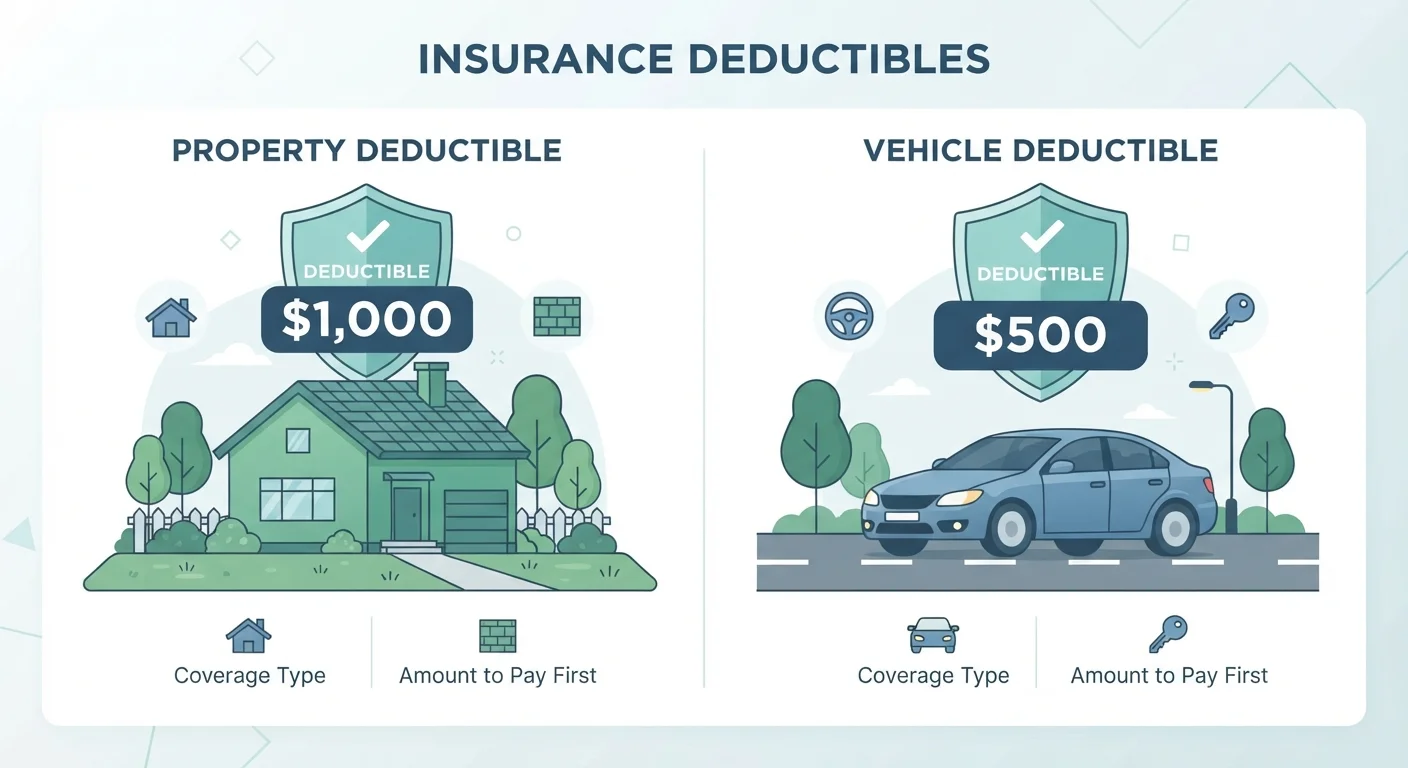
Photo: TargetReads.com | Explore Engaging Reads editorial
Key Takeaways
- A deductible is your share of a covered loss before the insurer pays the remainder.
- Higher deductibles generally lower your monthly or annual premium.
- Choosing the right deductible means balancing what you can pay upfront versus what you want to save on premiums.
- Some home policies use percentage-based deductibles for specific perils like wind or hail.
- Filing small claims just above your deductible may cost more over time than paying out of pocket.
- Your deductible does not apply to all policy benefits — liability coverage typically has none.
How a Deductible Functions Within a Claim
When a covered loss occurs — say, a storm damages your roof or another driver hits your parked car — your insurer calculates the total cost of that covered damage. Before they write you a check or pay a repair shop, your deductible amount is subtracted first.
Here is a straightforward breakdown of the math: if your home sustains $8,500 in storm damage and your deductible is $2,500, your insurer's payment is $6,000. You are responsible for the $2,500 regardless of who caused the damage or how the claim is resolved.
This structure serves a dual purpose. From the insurer's standpoint, it reduces the volume of very small claims and limits moral hazard — the tendency to be less careful about losses when someone else is footing the entire bill. From your standpoint, choosing to take on a deductible is a deliberate financial trade-off.
Deductibles and Liability Coverage Work Differently
It is worth reading your actual policy documents carefully, since deductible rules can differ by coverage type even within the same policy. For a broader look at how these policies are structured, see our guide to auto and home insurance fundamentals.
The Relationship Between Deductibles and Premiums
Your deductible and your premium move in opposite directions. When you elect a higher deductible, you are signaling to the insurer that you will absorb more of the risk yourself — so they charge you less in annual or monthly premiums. When you choose a lower deductible, the insurer carries more of the risk, and your premium reflects that.
$1,000
Most common home insurance deductible
Industry surveys consistently show $1,000 as the most frequently chosen flat deductible on standard homeowners policies in the United States.
1%–5%
Typical range for wind/hurricane percentage deductibles
According to the Insurance Information Institute, percentage-based deductibles for wind and hurricane perils commonly fall within this range on coastal homeowners policies.
This trade-off is one of the most consequential choices you make when buying or renewing a policy. A lower premium feels attractive month to month, but it means a larger bill landing on you at exactly the moment something goes wrong. Conversely, a higher deductible offers premium savings, but requires you to have enough liquid savings to cover that amount without financial strain.
Understanding how your deductible choice connects to your overall premium is one piece of a larger picture. Factors that influence auto insurance premiums covers the many other variables — like driving record, location, and credit score — that also shape what you pay.
Flat Dollar vs. Percentage-Based Deductibles
Most auto insurance policies and many home insurance policies use a flat dollar deductible — a fixed amount like $500, $1,000, or $2,500. This makes the math predictable: you always know exactly what you would owe in a claim scenario.
Some homeowners policies, particularly in regions prone to hurricanes, wind, or hail, include percentage-based deductibles for those specific perils. Instead of a flat amount, the deductible is calculated as a percentage — often 1% to 5% — of the home's insured replacement value. On a $350,000 home with a 2% wind deductible, that is $7,000 out of pocket before coverage begins. These figures can surprise policyholders who assume a flat deductible applies across the board.
Always check whether your home policy uses different deductible structures for different perils. The standard parts of a home insurance policy, decoded explains where to find these details within your policy documents.
Build a Dedicated 'Deductible Fund'
Choosing a Deductible That Fits Your Situation
There is no universally correct deductible amount. The right choice depends on your financial cushion, your risk tolerance, and your claims history. A few questions to weigh:
- Could you comfortably cover your deductible out of savings today? If the answer is no, a lower deductible provides more financial protection at the cost of a higher premium.
- How likely are you to file a claim? A driver with a spotless record and a garage-kept vehicle may reasonably choose a higher deductible. Someone in a high-risk flood or hail region may want a lower one for structures.
- Are you factoring in the break-even timeline? Calculate how many years of premium savings it takes to offset what you would pay in a worst-case claim. If the math takes a decade to break even, the higher deductible may not be worth it.
Keep in mind that deductibles in property insurance differ meaningfully from how cost-sharing works in health coverage. If you are also navigating health plan costs, see our explainer on deductibles, copays, and coinsurance to understand how those terms differ.
This article is for general informational purposes only and does not constitute personalized insurance, financial, or legal advice. Coverage terms, deductible structures, and eligibility vary by insurer and state. Always review your actual policy documents and consult a licensed insurance professional for guidance specific to your situation.
Frequently Asked Questions
The content on this site is for informational purposes only and is not a substitute for professional advice. Always consult a qualified professional for guidance specific to your situation.