
Hard Inquiries vs. Soft Inquiries: Why the Difference Matters

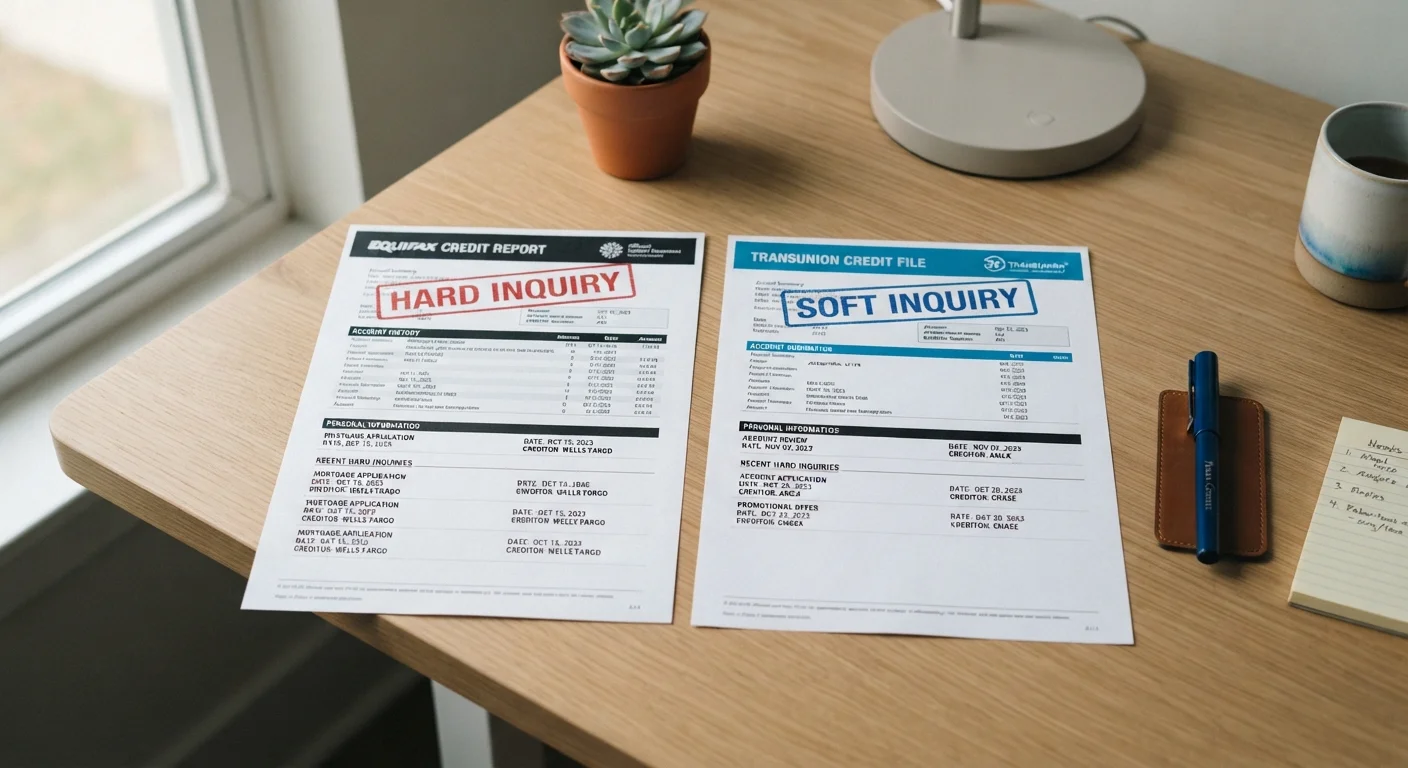
Photo: TargetReads.com | Explore Engaging Reads editorial
Key Takeaways
- Hard inquiries occur when you apply for credit and can temporarily lower your score by a few points.
- Soft inquiries never affect your credit score, regardless of how many occur.
- Multiple hard inquiries for the same loan type within a short window are typically counted as one by scoring models.
- You can check your own credit report anytime without triggering a hard inquiry.
- Hard inquiries remain on your credit report for two years but typically only affect your score for twelve months.
What Separates a Hard Inquiry from a Soft Inquiry
When a lender, employer, or landlord reviews your credit file, not all of those checks carry the same weight. The credit industry distinguishes between two categories: hard inquiries (also called hard pulls) and soft inquiries (soft pulls). The key difference lies in whether you are actively seeking new credit.
A hard inquiry happens when a financial institution accesses your full credit report as part of evaluating a formal application — for a credit card, personal loan, mortgage, or auto financing, for example. The lender needs a thorough picture of your creditworthiness to make a lending decision, and that review is recorded on your credit report as a hard inquiry.
A soft inquiry covers a wide range of other credit checks. When you check your own report, when a credit card issuer pre-screens you for a promotional offer, or when an employer runs a background check, these are all soft inquiries. They appear on a version of your credit report that only you can see — not the version lenders review — and they have zero effect on your credit score.
To understand how new credit applications fit into your overall credit profile, see the five factors behind every credit score.
| Criterion | Hard Inquiries | Soft Inquiries |
|---|---|---|
| Triggered by | Formal credit applications | Background checks, self-checks, pre-screenings |
| Affects credit score | Yes, temporarily | No effect |
| Visible to lenders | Yes | No (consumer-side only) |
| Stays on report | 2 years | Varies; not scored |
| Requires your permission | Yes, via application consent | Not always |
| Rate-shopping protection | Yes, within 14–45 days | N/A |
How Hard Inquiries Affect Your Credit Score
Hard inquiries are one of five factors that influence your credit score, though they carry relatively little weight — generally accounting for around 10% of a FICO score. In practice, a single hard inquiry might lower a score by fewer than five points for most consumers. The effect is temporary, typically fading within twelve months, even though the inquiry itself remains listed on your credit report for two years.
The more meaningful risk arises when multiple unrelated hard inquiries accumulate in a short period. Scoring models can interpret a cluster of applications as a sign that a consumer is seeking a lot of new credit at once, which is associated with higher lending risk. That said, scoring models are designed to accommodate rate-shopping: when you apply with several mortgage or auto lenders within a compressed window — generally 14 to 45 days depending on the model — those inquiries are typically consolidated and treated as a single event.
~5 pts
Typical score drop from a single hard inquiry
According to FICO, a single hard inquiry lowers most consumers' scores by fewer than five points, with the impact lasting up to twelve months.
10%
Weight of new credit in a FICO score
FICO's scoring model allocates approximately 10% of a score to the 'new credit' category, which includes hard inquiries and recently opened accounts.
45 days
Rate-shopping window for mortgage inquiries
FICO's newer scoring models allow up to 45 days for consumers to shop mortgage rates before counting multiple hard inquiries as more than one.
For a deeper look at what happens from application submission to a lender's decision, see what actually happens when you apply for credit.
Common Situations That Trigger Each Type
Knowing which everyday actions result in each type of inquiry helps you plan your credit activity with more confidence.
- Hard inquiries: Applying for a mortgage, auto loan, personal loan, student loan, credit card, apartment rental (some landlords), or certain utility accounts.
- Soft inquiries: Checking your own credit score or report, pre-qualification offers from lenders, employer background checks, credit limit reviews by your existing card issuer, and insurance underwriting checks in some states.
One important nuance: pre-qualification and pre-approval are not the same thing. Pre-qualification typically involves only a soft inquiry, allowing you to explore potential offers without affecting your score. A formal pre-approval, however, may require a hard inquiry. Always confirm which type a lender will use before proceeding.
Pre-Qualification vs. Pre-Approval
Because your credit file is accessed by multiple parties over time, it's worth knowing that your score can vary across the three bureaus — hard inquiries may appear on one bureau's report but not another's, depending on which bureau the lender pulled.
Managing Inquiries as Part of Your Credit Strategy
Because hard inquiries carry a temporary cost, it's worth being deliberate about when and how often you apply for new credit. If you're planning a major application — such as a mortgage — it's generally advisable to avoid opening new credit accounts in the months leading up to it. Each hard inquiry, even a small one, could be a factor when a lender evaluates your profile.
At the same time, one or two hard inquiries should not discourage you from applying for credit you genuinely need. The impact on a well-established credit file is modest. What matters more in the long run is your payment history and overall credit utilization. If you are considering closing an existing account to simplify your finances, review this checklist before closing a credit account — that decision can affect your score in ways unrelated to inquiries.
Monitoring your own credit regularly through soft inquiries is a sound habit. It lets you catch errors, spot potential fraud, and track your progress — all without any penalty to your score. This kind of informed oversight is one of the lower-effort, higher-value practices in personal financial management.
This article is for general informational purposes only and does not constitute personalized financial or credit advice. Consult a qualified financial professional regarding your individual situation.
The content on this site is for informational purposes only and is not a substitute for professional advice. Always consult a qualified professional for guidance specific to your situation.