
Employer-Sponsored Insurance vs. Marketplace Plans: Key Structural Differences

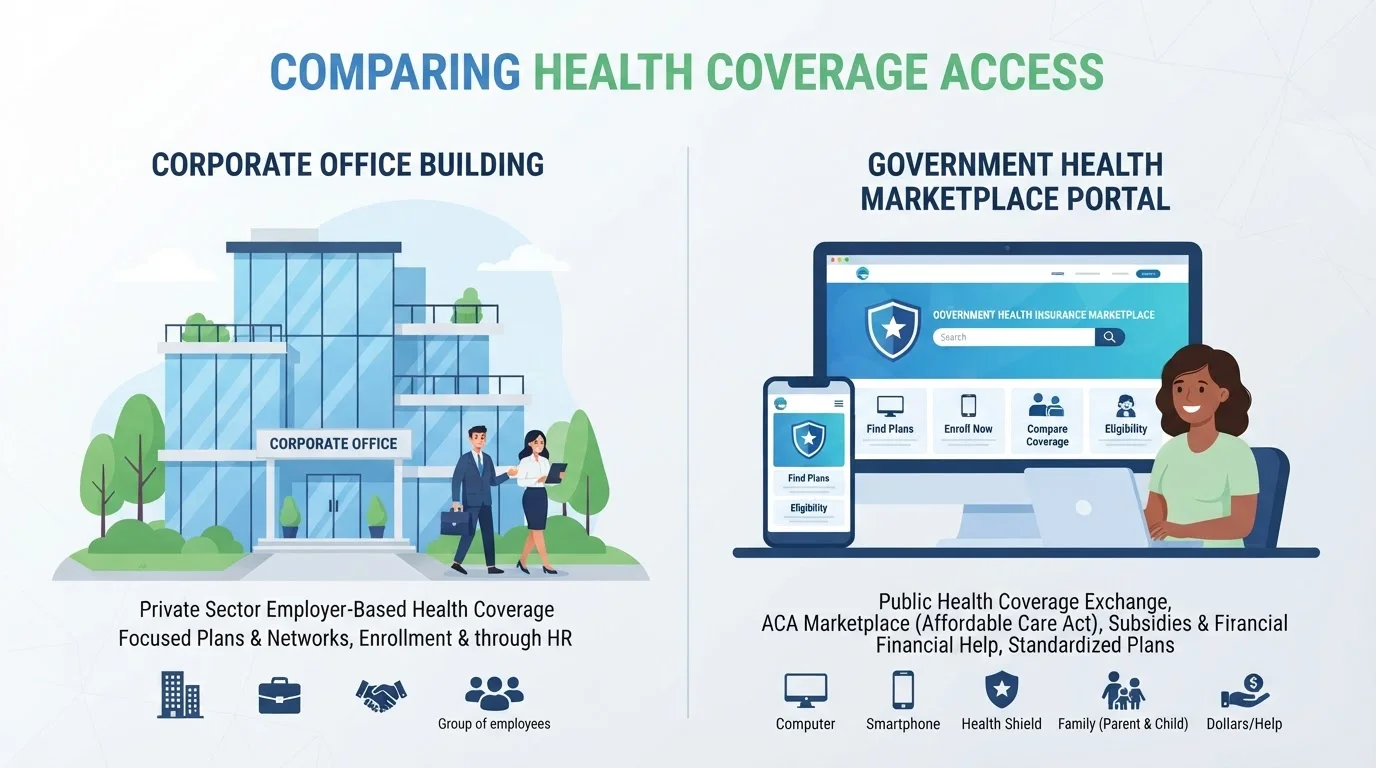
Photo: TargetReads.com | Explore Engaging Reads editorial
Key Takeaways
- Employer-sponsored plans are funded partly by your employer; Marketplace plans rely on premiums and government subsidies.
- Eligibility for job-based coverage depends on your employment status, not your income or household size.
- ACA Marketplace plans offer income-based subsidies unavailable through employer channels.
- Losing job-based coverage typically qualifies you for a Special Enrollment Period on the Marketplace.
- Both plan types must cover the ACA's ten essential health benefits, but cost structures differ significantly.
How Each System Is Structured
Employer-sponsored insurance (ESI) and ACA Marketplace plans are the two most common pathways to private health coverage in the United States. While both must meet federal standards for essential benefits, they operate through entirely different funding and eligibility frameworks.
Employer-Sponsored Insurance is a group plan arranged by an employer on behalf of its workforce. The employer typically pays a significant share of the monthly premium — federal law requires employers with 50 or more full-time equivalent employees to offer coverage that meets minimum value and affordability standards. Employees pay the remaining portion through pre-tax payroll deductions, which reduces their taxable income.
Marketplace Plans, sold through HealthCare.gov or state-run exchanges established under the Affordable Care Act (ACA), are individual or family plans purchased directly by the consumer. Eligibility is open to U.S. citizens and lawfully present residents who are not incarcerated and not enrolled in Medicare. Importantly, income-based premium tax credits and cost-sharing reductions are available only through the Marketplace — not through employer plans. For a broader look at how U.S. health coverage is organized, see the complete structural overview of U.S. health insurance.
Cost Structure: Premiums, Contributions, and Subsidies
Cost is often the most consequential difference between these two systems.
With employer plans, the employer's contribution effectively lowers what employees pay out of pocket. According to the Kaiser Family Foundation's annual Employer Health Benefits Survey, employers have historically covered a substantial majority of premium costs for single coverage. Employees pay the remainder via payroll, pre-tax, meaning the deduction also reduces federal income tax liability.
On the Marketplace, the full premium is the consumer's starting point. However, households with income between 100% and 400% of the federal poverty level — and in some years beyond that threshold, depending on legislation in effect — may qualify for premium tax credits that significantly reduce monthly costs. Cost-sharing reductions (CSRs) can also lower deductibles and copays for those who enroll in Silver-tier plans and meet income requirements.
One important nuance: if your employer offers coverage that meets the ACA's affordability and minimum value standards, you generally cannot claim Marketplace premium tax credits — even if you'd prefer a Marketplace plan. This is a structural constraint worth understanding before making any enrollment decision.
| Employer-Sponsored Insurance | ACA Marketplace Plan | |
|---|---|---|
| Who pays premiums | Employer + employee (shared) | Employee only (subsidies may apply) |
| Income-based subsidies | Not available | Premium tax credits and CSRs available |
| Eligibility basis | Employment relationship | Citizenship/residency and income |
| Enrollment timing | Hire date / annual open enrollment set by employer | Annual Open Enrollment Period or SEP |
| Pre-tax premium payment | Yes, via payroll deduction | Only through employer; not on Marketplace |
| Plan type options | Limited to employer's offering | Multiple types available to compare |
| Coverage when job ends | Ends (COBRA may extend temporarily) | Can enroll via SEP triggered by job loss |
Eligibility and Enrollment Windows
Eligibility rules differ substantially between the two systems.
Access to employer-sponsored coverage hinges on your employment relationship. Employers typically require a waiting period — often 60 to 90 days — before new hires become eligible. Coverage ends when employment ends (though COBRA continuation coverage may extend it temporarily, at full cost to the employee). Dependents can usually be added, though the employer is not required to contribute toward dependent premiums.
The Marketplace uses annual Open Enrollment Periods, generally in the fall for coverage beginning the following January. Outside of that window, you can only enroll if you experience a qualifying life event — such as losing employer coverage, getting married, or having a child — which triggers a Special Enrollment Period (SEP). Losing job-based coverage is itself a qualifying event, creating a natural bridge between the two systems.
Before your next enrollment window, it's worth reviewing what you'll actually need to assess. The open enrollment preparation checklist walks through the key questions to answer before locking in a plan.
Check Affordability Before Assuming You Must Use Employer Coverage
Plan Types, Networks, and Flexibility
Both employer and Marketplace plans can be structured as HMOs, PPOs, EPOs, or POS plans — the plan type governs how networks and referrals work, not the enrollment channel. That said, the range of plan types available to you will depend on what your employer offers or what's sold in your state's Marketplace.
Employer plans can offer narrow or broad networks depending on the insurer the company contracts with. Employees generally have limited ability to influence which network model their employer selects. Marketplace shoppers, by contrast, can browse multiple plan types and network configurations side by side, choosing the structure that best fits their care needs and budget. For a breakdown of how HMO and PPO structures compare on cost and flexibility, see HMO vs. PPO trade-offs. For a broader look at all four main plan structures, the HMO, PPO, EPO, and POS explainer covers each in detail.
It's also worth noting that employer benefits packages often bundle other coverages — such as group life insurance — alongside health plans. Understanding those add-ons separately matters; see what group life insurance through your employer includes and leaves out for context.
This article is for general informational and educational purposes only and does not constitute personalized insurance, financial, or legal advice. Coverage terms, eligibility, costs, and regulations vary by provider, employer, and state. Consult a licensed insurance agent or adviser for guidance specific to your situation.
The content on this site is for informational purposes only and is not a substitute for professional advice. Always consult a qualified professional for guidance specific to your situation.