
Paying Off Debt While Saving at the Same Time: How the Math Actually Works

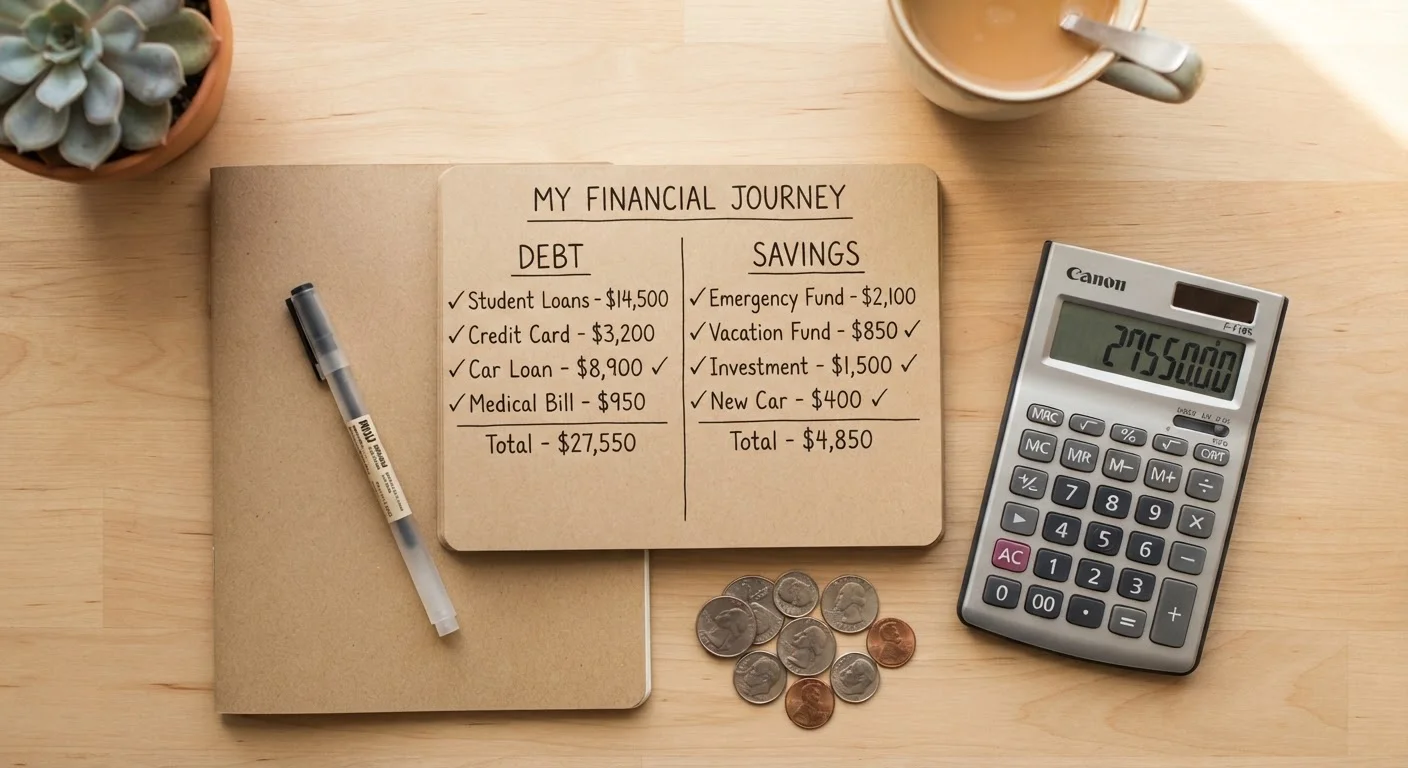
Photo: TargetReads.com | Explore Engaging Reads editorial
Key Takeaways
- Paying off high-interest debt and building a small emergency fund simultaneously is mathematically sound for most households.
- The interest rate on your debt is the critical number that determines how aggressively to prioritize repayment over saving.
- A starter emergency fund of $500–$1,000 can prevent new debt from undoing payoff progress.
- Splitting surplus income between debt and savings requires a deliberate allocation decision, not guesswork.
- Employer retirement matches are a guaranteed return that often outweighs paying down lower-interest debt first.
- Regular monthly reviews keep your split aligned with changing balances and income.
Why the Either/Or Mindset Falls Short
The instinct to throw every spare dollar at debt — or, conversely, to save aggressively while making only minimum payments — is understandable. Both feel decisive. But for most households, a rigid either/or approach ignores the real math at play.
Consider what happens when you funnel everything into debt and skip saving entirely: the first unexpected car repair or medical copay lands on a credit card, potentially erasing weeks of payoff progress. Conversely, saving heavily while carrying high-interest debt means your savings yield is almost certainly lower than the interest rate draining your balance. Neither extreme is optimal.
The productive framing is: debt repayment and saving are not competing goals — they are complementary financial defenses. The question is not which to do, but how to split your available dollars intelligently. For a broader foundation, see our complete saving and debt management framework.
Small Emergency Fund Pays for Itself
The Core Math: Interest Rates Are the Deciding Variable
The central calculation is straightforward: compare the interest rate on your debt against the expected return on your savings or investments. If your credit card charges 22% APR and a high-yield savings account returns roughly 4–5%, every dollar used to pay down that card earns an effective 22% return — far outpacing what saving that dollar would achieve.
This logic shifts when debt carries lower rates. A federal student loan at 5% or a fixed auto loan at 6% does not carry the same mathematical urgency. In those cases, directing some dollars toward savings — particularly a tax-advantaged retirement account — may produce equal or better long-term outcomes. For a deeper look at how rate differences change the equation, see our explainer on high-interest vs. low-interest debt.
One reliable exception: employer 401(k) matching contributions. If your employer matches a percentage of your contributions, capturing that match is effectively a 50%–100% instant return on that portion — an outcome that virtually no debt payoff rate can beat. Contribute at least enough to earn the full match before accelerating debt payments beyond minimums.
Minimum Payments Are a Floor, Not a Strategy
How to Set Up Your Split: A Step-by-Step Approach
Once you understand the underlying math, the practical work begins. The steps below provide a repeatable process for allocating limited income across both goals without stalling either.
What you will need
List Every Debt and Its Interest Rate
Write out each debt — credit cards, personal loans, student loans, auto loans — with its current balance, interest rate (APR), and required minimum payment. Sort the list from highest to lowest APR. This single document becomes the foundation for every allocation decision you make.
Fund a Starter Emergency Buffer First
Before splitting surplus dollars, direct enough savings to reach a small but meaningful emergency buffer — typically $500 to $1,000. This amount is not a full emergency fund; it is a circuit breaker designed to absorb minor unexpected expenses without reaching for a credit card. Once this buffer exists, you can pursue debt payoff more aggressively without the constant risk of backsliding.
Capture Any Employer Retirement Match
If your employer offers a retirement plan match, calculate the contribution percentage needed to receive the full match. Contribute at least that amount before directing extra dollars toward debt. A 50% or 100% match is a guaranteed return no debt payoff strategy can reliably beat. If no match is available, skip this step until high-interest debt is resolved.
Apply a Rate Threshold to Allocate Remaining Surplus
Use your sorted debt list and a simple rate threshold to decide where remaining surplus dollars go. A common benchmark: debts carrying an APR above roughly 7%–8% should typically receive extra payoff dollars before additional savings contributions. Debts below that threshold can often be managed with minimums while you direct more toward savings or investments. Adjust the threshold based on your personal risk tolerance and current savings yields.
For a structured way to think about both numbers at once, see savings rate vs. debt payoff rate.
Set a Fixed Monthly Allocation and Automate It
Translate your split into a concrete dollar amount for each goal and automate the transfers. For example: if your monthly surplus is $400, you might direct $280 to extra debt payments and $120 to your savings account. Automation removes the monthly decision point and reduces the chance that surplus dollars drift into discretionary spending.
Expand Savings Once High-Interest Debt Is Cleared
When debts above your rate threshold are paid off, redirect those payment dollars toward building a full emergency fund (typically three to six months of essential expenses) and longer-term savings goals. At this stage, the mathematical case for aggressive saving strengthens considerably because the high-interest drag on your finances has been eliminated.
For guidance on which specific payoff sequence to use once your split is set, the avalanche and snowball methods offer two well-tested approaches. You can also track your progress systematically using a monthly financial reset checklist.
This article provides general financial information and education only and is not personalised financial, investment, tax, or legal advice. Consult a qualified financial professional regarding decisions specific to your circumstances.
The content on this site is for informational purposes only and is not a substitute for professional advice. Always consult a qualified professional for guidance specific to your situation.