
The Skincare Ingredient Glossary: A Plain-English Reference

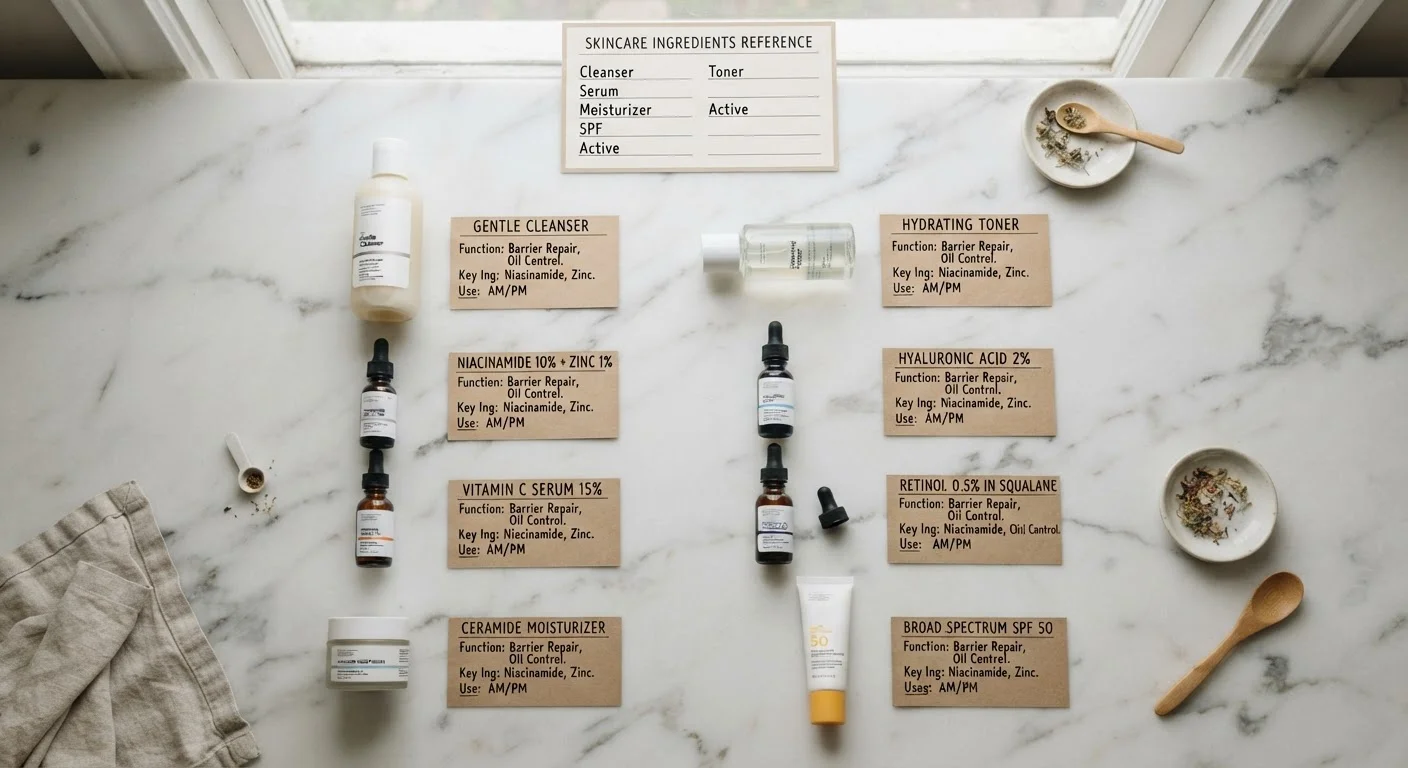
Photo: TargetReads.com | Explore Engaging Reads editorial
Why Ingredient Labels Matter
If you've ever flipped a serum bottle over and felt your eyes glaze at the ingredient list, you're in good company. Most skincare labels read like a chemistry exam — and that's a problem, because what goes into a product matters just as much as what it claims to do on the front.
This plain-English glossary covers the terms you're most likely to encounter, organized so you can look up any ingredient quickly. Whether you're building your first routine or just trying to decode a new purchase, knowing these key players helps you shop smarter and layer products more confidently. For context on how these ingredients interact with different complexions, see our guide on what your skin type really means.
Hyaluronic Acid
A humectant — a moisture-attracting molecule — that draws water into the skin's outer layers. It occurs naturally in the body and is well tolerated by most skin types, including sensitive. Found in serums, moisturizers, and toners.
Niacinamide
A form of vitamin B3 that helps support the skin barrier, even out skin tone, and minimize the appearance of pores. It's generally gentle enough for daily use and plays well with most other ingredients.
AHA (Alpha Hydroxy Acid)
A class of water-soluble exfoliating acids — including glycolic and lactic acid — that work on the skin's surface to loosen dead cells and promote a smoother, more even texture. Most effective for dry or sun-damaged skin.
BHA (Beta Hydroxy Acid)
An oil-soluble exfoliating acid, most commonly salicylic acid, that can penetrate into pores to clear out excess sebum and debris. Particularly useful for oily or acne-prone skin.
Retinol / Retinoid
Vitamin A derivatives that support cell turnover and collagen production. Retinoids (the prescription category) are stronger; retinol is the over-the-counter form. Both can cause initial dryness or flaking and require gradual introduction.
Vitamin C (L-Ascorbic Acid)
An antioxidant that helps brighten skin tone and protect against environmental stressors like UV exposure and pollution. Most potent in its pure L-ascorbic acid form, though less stable than derivatives like ascorbyl glucoside.
Ceramide
Lipids (fats) that occur naturally in the skin and form a key part of the skin barrier. Ceramide-containing moisturizers help reinforce this barrier, making them especially helpful for dry or compromised skin.
Peptide
Short chains of amino acids that serve as building blocks for proteins like collagen and elastin. In skincare, peptides are used to support firmness and skin structure, though evidence strength varies by specific peptide.
SPF (Sun Protection Factor)
A measure of how well a sunscreen protects against UVB rays, the type most associated with sunburn and skin damage. Dermatologists broadly recommend SPF 30 or higher for daily use, rain or shine.
Occlusives
Thick, film-forming ingredients — such as petrolatum, beeswax, or shea butter — that create a physical barrier on the skin's surface to lock in moisture. Often found in the final step of a routine, like a night cream or balm.
Emollient
Ingredients that soften and smooth the skin by filling gaps between skin cells. Common emollients include plant oils, squalane, and fatty alcohols. They sit between lightweight humectants and heavy occlusives in terms of texture.
Exfoliant
Any ingredient or physical agent that removes dead skin cells from the skin's surface. Chemical exfoliants (AHAs, BHAs, PHAs) use acids; physical exfoliants use particles or tools. Over-exfoliating can disrupt the skin barrier.
Key Ingredient Categories at a Glance
Skincare ingredients generally fall into a handful of functional categories — humectants, exfoliants, antioxidants, retinoids, and emollients among them. Understanding the category tells you roughly what a formula is trying to accomplish before you even read the active ingredients.
| Most common humectant | Hyaluronic Acid |
| Exfoliant types | AHA (water-soluble), BHA (oil-soluble), PHA (gentler option) |
| Retinol introduction pace | 2–3 nights per week to start; increase gradually (General dermatological guidance) |
| Minimum daily SPF | SPF 30 (broad spectrum) (American Academy of Dermatology) |
| Layering order (general) | Thinnest to thickest — cleanser → toner → serum → moisturizer → sunscreen (AM) |
| Time to see results | Most actives: 4–12 weeks of consistent use (General dermatological guidance) |
Humectants like hyaluronic acid draw moisture from the air (or deeper skin layers) into the outer skin. Exfoliants such as AHAs and BHAs accelerate the natural shedding of dead skin cells. Antioxidants — think vitamin C and niacinamide — help neutralize environmental stressors. Retinoids work at a cellular level to support skin turnover. Emollients and occlusives round out a routine by softening skin and sealing moisture in.
If the language on hair care products feels equally confusing, our grooming ingredients glossary applies the same plain-language approach to shampoos and conditioners.
PHA: The Gentler Exfoliant Option
Building a Routine Around What You Now Know
Knowing what an ingredient does is only half the picture — the other half is understanding how to layer or sequence products without causing irritation. As a general principle, apply thinner, water-based formulas (like serums) before thicker ones (like moisturizers). Avoid combining potent actives — such as a retinoid and a high-concentration AHA — on the same night until you know how your skin responds.
Start with one new active at a time, introduce it slowly (a few nights per week), and give your skin at least four weeks before judging results. Most importantly, daily SPF is non-negotiable when using any exfoliating acid or retinoid, since these ingredients can increase sun sensitivity.
Ready to put this knowledge into practice? Our beginner's skincare guide walks through a simple, consistent routine framework that doesn't require a shelf full of products.
This article is for general informational and educational purposes only. It is not medical or dermatological advice. If you have a skin condition, sensitivity, or concerns about a specific ingredient, consult a qualified dermatologist or healthcare professional.
The content on this site is for informational purposes only and is not a substitute for professional advice. Always consult a qualified professional for guidance specific to your situation.