
Home Internet Connection Types, Decoded

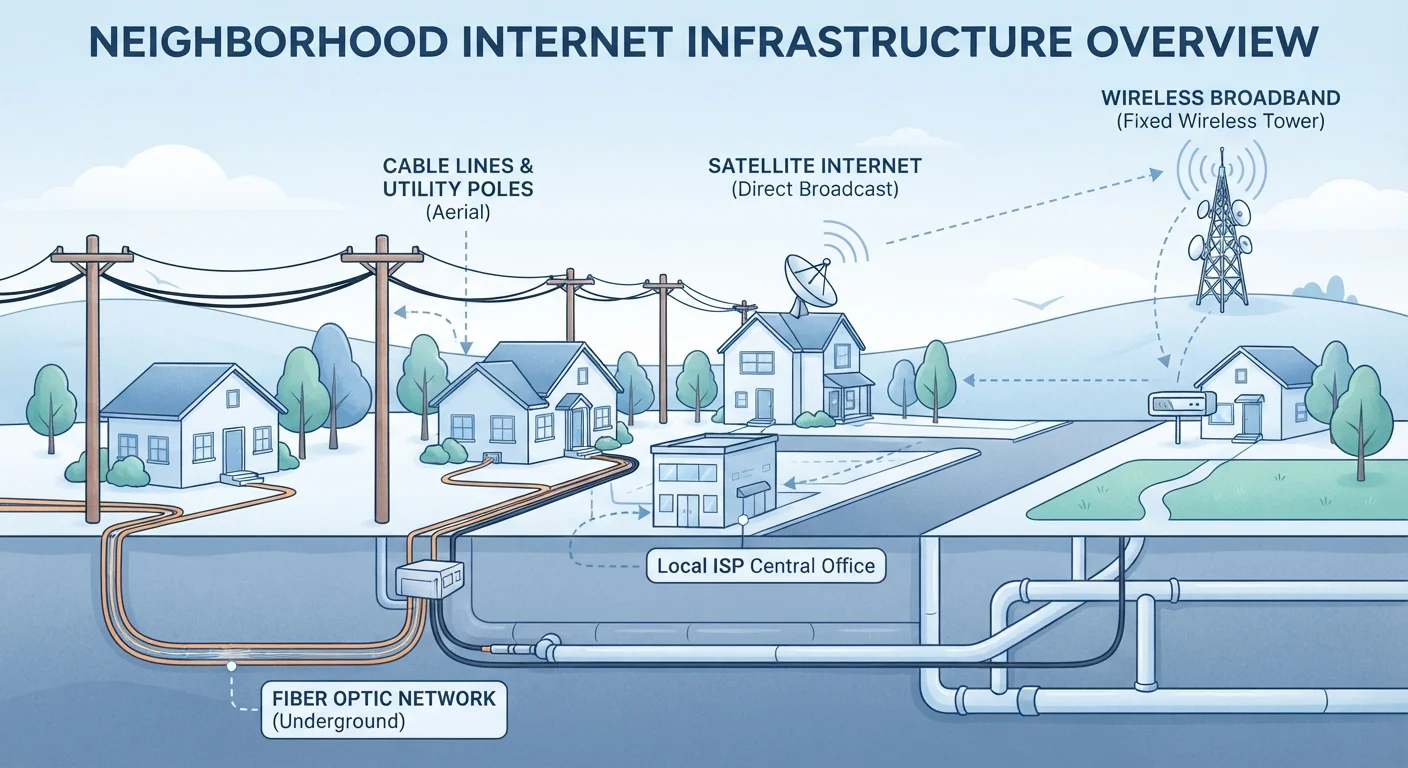
Photo: TargetReads.com | Explore Engaging Reads editorial
Why Your Connection Type Matters
Not all home internet connections are built the same. The technology that carries data to your door affects your speed, reliability, and the consistency of your connection during peak hours. Knowing what's actually running into your home helps you set realistic expectations—and ask better questions when something goes wrong.
There are five main connection types available to U.S. households today: DSL, cable, fiber, fixed wireless, and satellite. Availability depends heavily on your location. Urban and suburban areas typically have multiple options; rural areas may have only one or two.
| DSL medium | Copper telephone wire |
| Cable medium | Coaxial cable |
| Fiber medium | Glass or plastic optical strands (light pulses) |
| Fixed wireless medium | Radio waves from a ground-based tower |
| Satellite medium | Radio waves via orbiting satellite |
| Technology most affected by distance | DSL |
| Technology with lowest latency potential | Fiber and LEO satellite |
| Technology most common in rural areas | Satellite and fixed wireless |
Once you understand how each technology works, decisions about plans, equipment, and troubleshooting become much clearer. For a deeper look at how speed figures translate to real-world use, see our bandwidth explainer.
The Five Main Connection Types, Explained
DSL (Digital Subscriber Line)
DSL delivers internet over the same copper telephone wires that carry landline phone service. A device called a DSL modem separates the internet signal from the phone signal, so both can share the line simultaneously. Because the signal degrades over distance, your connection speed is directly tied to how far your home sits from your provider's local facility. Homes close to that facility may see reasonable speeds; those farther away often experience noticeably slower performance.
Cable
Cable internet travels over the same coaxial cable infrastructure used to deliver cable television. It typically supports higher speeds than DSL because coaxial cable carries more bandwidth than copper telephone wire. One practical consideration: cable networks are shared among nearby subscribers. During peak evening hours, when many households in the same area are online simultaneously, speeds can dip. This is sometimes called network congestion.
Fiber Optic
Fiber uses pulses of light transmitted through thin glass or plastic strands to carry data. Because light doesn't degrade over distance the way electrical signals do, fiber connections tend to offer consistent speeds regardless of how far you are from the provider's hub. Fiber also commonly provides symmetrical speeds—meaning upload speeds match download speeds—which matters for video calls, remote work, and cloud backups. Availability remains limited in many regions because laying fiber infrastructure is costly. Fiber and cable have distinct trade-offs worth understanding if both are available where you live.
Fixed Wireless
Fixed wireless transmits internet signals through radio waves from a nearby tower to a small antenna or receiver mounted on your home. No physical cable runs to the house. Performance depends on line-of-sight distance to the tower and local terrain; hills, dense trees, and buildings can interfere. Fixed wireless has expanded significantly as a rural broadband option in recent years.
Satellite
Satellite internet bounces signals between your home dish and an orbiting satellite. Traditional geostationary satellites sit roughly 22,000 miles above Earth, which introduces significant latency—the delay between sending a request and receiving a response. Low-earth orbit (LEO) satellite systems operate much closer to Earth, substantially reducing latency compared to older satellite technology, though weather can still affect performance.
Latency
The time it takes for a data request to travel from your device to a server and back, measured in milliseconds. High latency makes video calls and online gaming feel sluggish even when download speeds seem adequate.
Bandwidth
The maximum amount of data that can travel through a connection in a given time, usually measured in Megabits per second (Mbps). Higher bandwidth allows more data to move simultaneously.
Symmetrical Speed
A connection where upload and download speeds are equal. Fiber connections often offer symmetrical speeds, while cable and DSL typically provide much faster downloads than uploads.
Network Congestion
A slowdown that occurs when many users on the same shared network segment are online at the same time. Cable internet is more susceptible to congestion than fiber.
Coaxial Cable
A type of electrical cable with a central conductor surrounded by insulation and a shielded outer layer. Originally designed for TV signals, it is also used to carry cable internet.
Low-Earth Orbit (LEO) Satellite
A satellite positioned between roughly 300 and 1,200 miles above Earth. LEO satellites have much lower latency than traditional geostationary satellites because signals travel a shorter distance.
Choosing and Troubleshooting Your Connection
Your first step is identifying which technologies are actually available at your address—not just in your general area. Check directly with local providers or use your zip code on a coverage-lookup tool. In many cases, your choice is limited by geography, not preference.
Once connected, poor performance isn't always the network's fault. Router placement, outdated equipment, and the number of devices sharing your connection all play a role. Before assuming your plan is the problem, run through an in-home audit first.
If you're setting up internet service for the first time, our home network setup guide covers modem placement, router configuration, and basic security steps. And if you're weighing plan tiers, speed plan myths are worth reading before paying for higher Mbps you may not need.
Connection Type Doesn't Guarantee Speed
The content on this site is for informational purposes only and is not a substitute for professional advice. Always consult a qualified professional for guidance specific to your situation.